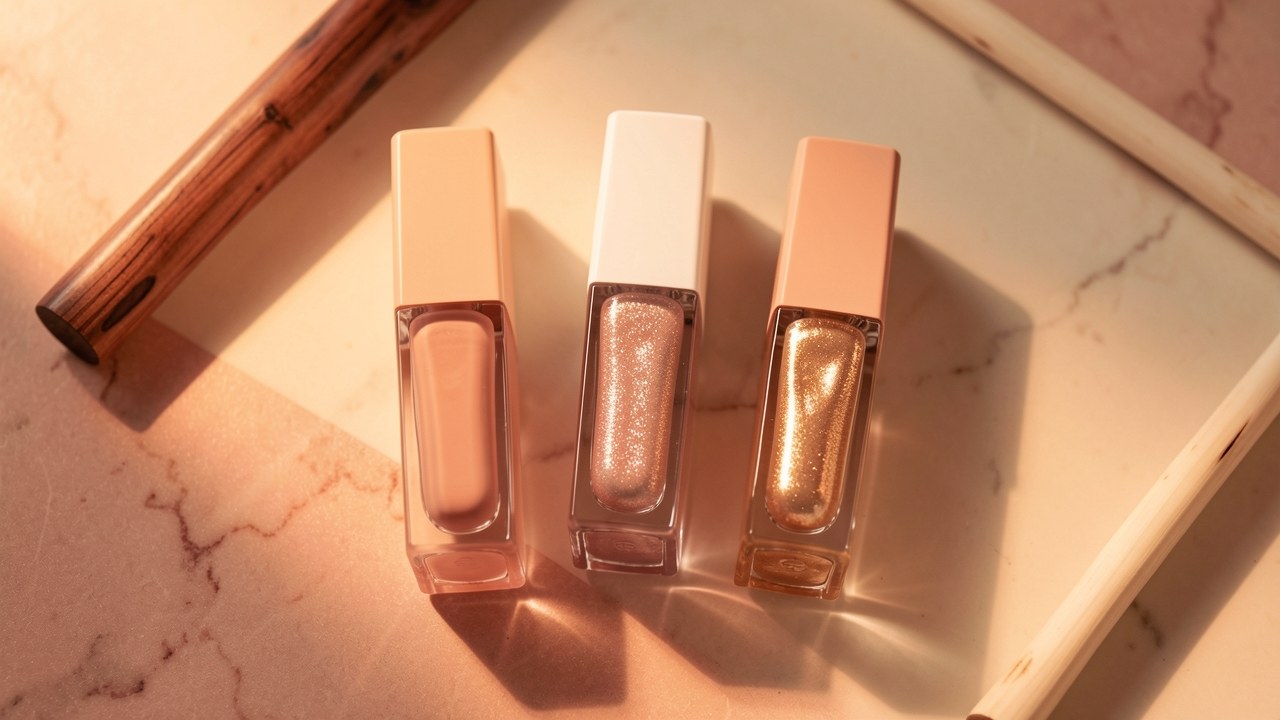
What lip gloss is, and how it differs from other lip color
Lip gloss is a cosmetic product category built primarily to add shine and a reflective finish to the lips, which sets it apart from flat matte color. That defining emphasis on reflection is how category sources separate gloss from lipsticks and stains that are judged mainly on pigment.
The distinction matters in practice because it changes what you are shopping for. When you buy color, you are choosing a shade and an opacity level. When you buy gloss, you are choosing a surface effect first, and pigment second. A gloss can deliver almost no color and still do exactly what it was designed to do.
The category is not simple underneath the shine. A peer-reviewed review of cosmetic matrix composition describes cosmetic formulations, including gloss-type products, as complex blends of preservatives, emulsifiers and thickeners. That is one reason two products that look identical in the tube can feel completely different on the lips.
- Primary job: add shine and a reflective, dimensional finish.
- Color is optional; many glosses are clear or barely tinted.
- Formulation is a blend of several component classes, not a single ingredient.
- A gloss, a lipstick and a lip oil can share ingredients yet behave differently because of how they are balanced.
Sources: DataIntelo, Molecules (peer-reviewed, PMC10818968), Lipstick Queen
Common finish types: clear, sheer tint, shimmer, and high-shine
Finish taxonomy across the category is broad and not perfectly standardized. Named finish types include clear, sheer, tinted, shimmer, matte, metallic, pigmented, creamy and high-shine or glossy, so you may see the same product described with different labels by different sellers.
Clear gloss is a zero-pigment transparent coating. Its main uses are enhancing the natural lip color and layering over color you already applied. Sheer tint gloss carries minimal pigmentation and a translucent tint with a glossy sheen, which makes it a natural everyday option for adding dimension to bare lips.
High-shine glossy finishes aim for maximum reflectivity and a glass-like, wet appearance, and they are typically positioned for glamorous occasions and photo-ready looks. Matte gloss sits at the opposite end: a non-reflective, velvety finish with shine-free pigmentation, chosen by people who want color without any glossiness.
| Finish type | Defining finish feature | Primary use case |
|---|---|---|
| Clear gloss | Zero-pigment transparent coating | Enhancing natural lip color; layering over other lip color |
| Sheer tint gloss | Minimal pigmentation, translucent tint with glossy sheen | Everyday wear; adding dimension to bare lips |
| High-shine glossy | Maximum reflectivity, glass-like mirror shine with wet appearance | Glamorous occasions and photo-ready looks |
| Matte gloss | Non-reflective velvety finish, shine-free pigmentation | Users who prefer a shine-averse finish |
Sources: DataIntelo, Lipstick Queen
Shimmer, metallic, and where tinted lip oil fits
Shimmer and metallic sit within the wider finish vocabulary rather than as separate product classes. They change how light interacts with the surface of the lips, which means they read differently in daylight and in indoor lighting. If you are weighing a shimmer finish against a plain gloss, the honest comparison is about the visual effect you want, not about which one performs better.
A related but distinct category is tinted lip oil. One brand comparison describes lip oil as using more plant-derived oils and butters without heavy waxes and polymers, which gives a more fluid, lighter texture than traditional gloss. Contract-manufacturer descriptions place tinted lip oil inside the same development family as sheer, matte and cream gloss styles, with a natural glossy finish as its shine positioning.
That positioning helps explain why lip oil often feels like the lighter end of the glossy lip spectrum. If a traditional gloss feels heavy to you, a tinted oil is the adjacent category to explore, and it is covered in more depth in our dedicated lip oil guide.
- Shimmer and metallic describe light behavior on the surface rather than a separate formulation class.
- Tinted lip oil is gloss-adjacent, generally positioned as lighter and more fluid.
- Development of gloss styles typically finalizes base type, opacity, texture, finish and optional additives together.
Sources: Global Cosmetics, BostonMints
Texture and stickiness: what actually affects comfort
Tackiness is the single most common complaint about gloss, and it is not simply the price of shine. Editorial testing has noted that tackiness and shine level are not perfectly coupled: some high-shine glosses are perceived as gummy or tacky while others are not. In other words, a mirror finish does not automatically mean a sticky mouth.
Traditional category framing holds that high-shine glosses are often sticky while lighter modern formulations are not, and that finish materially affects the overall look. Trade coverage of gloss testing describes a broader shift away from tackiness toward longer-wearing pigment and conditioning ingredients with a more balm-like texture.
Formulation explains much of this. Ingredient overviews group gloss components into oils, waxes, pigments and dyes, emollients, polymers, thickeners, humectants, preservatives, antioxidants, UV filters and special additives. Polymers such as silicones, isododecane, cyclopentasiloxane and trimethylsiloxysilicate are described as enhancing wearability, adhesion and shine while providing a non-sticky, smooth application. Waxes, including beeswax, candelilla, rice bran, carnauba and others, contribute structure, texture and adherence.
Ingredient listings are representative examples of ingredient classes rather than complete or exhaustive catalogues, and they do not tell you the concentration used in any particular product. So treat the ingredient list as a vocabulary for reading labels, not as a promise about how a specific tube will feel.
- Shine and tackiness are separate qualities; one does not guarantee the other.
- Waxes contribute structure and adherence; too much can read as heavy.
- Polymers are associated with adhesion, wear and a smoother, less tacky feel.
- Gelling systems such as carbomer and carrageenan-based systems are described as producing a smooth, cushioning, water-like clarity texture in gel formats.
- Ingredient class lists do not reveal concentrations, so label reading has limits.
Sources: Rude Cosmetics, DataIntelo, New York Magazine – The Strategist, WWD, PickBest UK
Wear time and reapplication expectations
There is no standardized measurement protocol for gloss longevity in the sources available, so wear time should be treated as an expectation rather than a rule. Editorial testing states a standard gloss wear time of about two hours before reapplication, with acceptance varying by whether the user is eating or drinking.
Another source describes a qualitative relationship instead of a figure: thicker glosses generally wear longer on the lips, and hydrating or conditioning ingredients help prevent the dryness that can shorten wear. A market report on the category does not supply a wear figure at all.
Editorial testing has also noted that gloss finishes break down toward a balmy texture over time. That is a useful mental model: the shine phase is the short part, and what remains afterward is closer to a balm. If you want the reflective look to hold, plan on touching up rather than expecting a full day from a single application.
- Expect the shine phase to be shorter than the color phase.
- Eating and drinking are common reasons wear acceptance varies.
- Thicker formulas are generally described as wearing longer.
- Conditioning ingredients are described as helping prevent dryness that shortens wear.
- There is no standardized test protocol behind published wear figures.
Sources: DataIntelo, New York Magazine – The Strategist, Lemon8
Layering gloss over balm, liner, or lipstick
Layering is where gloss earns its place in a routine, because a clear or sheer gloss can change the finish of color you already own without changing the color itself. The order you apply things in determines which layer dominates.
A practical sequence for a polished, longer-looking result is to prepare the lip surface first, define the shape second, add color third, and gloss last. Gloss belongs at the end because it is the most mobile layer; applying it earlier means the layers above it will disturb it.
Keep in mind that adding gloss over a matte or long-wear color will change that product's finish and typically reduce its wear. That is not a defect, it is the trade-off. If holding color all day matters more to you than shine, wear the gloss on its own or reserve it for occasions.
- Start with a balm or thin conditioning layer if your lips feel dry, and let it settle for a moment.
- Define the lip line with a liner if you want a crisper edge or more shape.
- Apply your lipstick or tint and blot if you want a softer, less slippery base.
- Add gloss last, starting at the center of the lip and blending outward with the applicator.
- Press rather than rub your lips together to avoid pushing the gloss past the lip line.
- Reapply gloss only, rather than rebuilding every layer, when the shine fades.
Choosing a gloss for daily wear versus occasion wear
Daily and occasion glosses are optimizing for different things. Daily wear favors comfort, low maintenance and a finish that still looks reasonable after it starts to fade. Occasion wear favors maximum visual impact for a defined window of time, which is why high-shine finishes are often positioned for glamorous, photo-ready looks.
For daily use, the useful priorities are a texture you do not notice, a finish that degrades gracefully toward balm, and a level of pigment you are willing to reapply. Sheer tints and clear glosses fit this profile because their failure mode is subtle. For occasion use, priorities shift toward reflectivity and definition, and reapplying more often is an acceptable cost.
Wear time matters differently in each case. A two-hour shine phase is fine for a dinner reservation and inconvenient for a full workday. Decide which one you are shopping for before you compare finishes, because the same product can be excellent for one and frustrating for the other. If your goal is specifically to stretch color wear, the techniques in our guide on making lip color last are the more relevant starting point.
- Daily wear: comfort and graceful fading outrank maximum shine.
- Occasion wear: reflectivity and definition outrank low maintenance.
- Pigment level determines how obvious a fading gloss looks.
- Match the shine phase to the length of the event, not to the whole day.
Sources: Lipstick Queen, New York Magazine – The Strategist, WWD
Side-by-side category and decision-criteria matrix
A decision matrix is a structured tool that compares options against weighted, well-defined criteria to produce a total score that supports a selection. It works well for gloss because the category forces trade-offs: shine against tackiness, wear against comfort, pigment against forgiveness.
The method has consistent steps across practitioner references. It applies when all criteria are equally important as an unweighted matrix, or when criteria carry different importance as a weighted matrix. Best practice is that criteria be well-defined, non-overlapping and aligned with the decision goal, because fuzzy or overlapping criteria make the process subjective.
The table below is a category-and-criteria reference, not a product ranking. Use the criteria as prompts and score your own options against them; the value comes from making your trade-offs explicit, not from the totals themselves.
- Identify the criteria that matter to you, such as shine, comfort, color payoff, wear time, layering behavior and reapplication tolerance.
- Assign a weight to each criterion, commonly on a 1 to 10 scale, reflecting how much it matters for the context you are buying for.
- List the specific finishes or formulation styles you are considering as the alternatives.
- Score each alternative against each criterion on a consistent scale.
- Multiply each weight by each score, then sum the results to get a total per alternative.
- Sanity-check the winner against your own experience before treating the total as a decision.
| Criterion | What it measures | Favors |
|---|---|---|
| Shine level | Reflectivity of the finish, from matte through clear to high-shine | Occasion wear and photo-ready looks |
| Comfort and tackiness | Whether the texture feels smooth or gummy in use | Daily wear and long conversations |
| Color payoff | How much pigment the finish delivers on its own | Wearing gloss alone without lipstick |
| Wear time | How long the finish holds before the shine phase fades | Events, meals, and low-maintenance days |
| Layering behavior | How well the finish sits over balm, liner or lipstick | Anyone building on existing color |
| Reapplication tolerance | How willing you are to touch up during the day | High-shine and high-pigment choices |
Sources: ChartExpo, awork, The Decision Lab, Smartsheet
Frequently asked questions
Is lip gloss supposed to be sticky?
Not necessarily. Tackiness and shine level are not perfectly coupled, and editorial testing has noted that some high-shine glosses are perceived as gummy or tacky while others are not. The traditional category concern is that high-shine glosses are often sticky while lighter modern formulations are not, and trade coverage describes a shift away from tackiness toward longer-wearing pigment and conditioning ingredients with a balm-like texture. Formulation is the reason, not shine itself: polymers such as silicones and trimethylsiloxysilicate are described as providing a non-sticky, smooth application while supporting adhesion and wear.
Sources: Rude Cosmetics, New York Magazine – The Strategist, WWD, PickBest UKCan lip gloss be worn alone without lipstick?
Yes. Clear gloss and sheer tint gloss are both designed to work on bare lips, and clear gloss is specifically used to enhance natural lip color as well as to layer over other color. Matte gloss is also a standalone finish, since it carries its own pigmentation with a non-reflective, velvety look. What changes when you skip lipstick is the amount of color and the definition of the lip line, so if you want more shape you would add liner rather than lipstick.
Sources: Lipstick QueenDoes lip gloss dry out lips over time?
The sources here do not support a simple yes or no. What they do describe is that thicker glosses tend to wear longer, and that hydrating or conditioning ingredients help prevent dryness that can shorten wear. Ingredient overviews list humectants and hydrators such as sodium hyaluronate, glycerin, aloe vera, squalane and sodium PCA as components used in some gloss formulas. That is an ingredient-class description rather than a treatment or clinical claim, and no source here establishes that gloss causes or prevents dryness on its own.
Sources: Rude Cosmetics, Lemon8How often should lip gloss be reapplied?
Editorial testing states a standard gloss wear time of about two hours before reapplication, with acceptance varying by whether you are eating or drinking. There is no standardized measurement protocol behind published wear figures, so treat that as an expectation rather than a rule. Two things are worth knowing: thicker formulas are generally described as wearing longer, and gloss finishes break down toward a balmy texture over time, so the shine phase ends before the product is fully gone. If you want the reflective look to hold, touch up the gloss layer only rather than rebuilding every layer.
Sources: New York Magazine – The Strategist, Lemon8Sources
- What is Lip Gloss Made of? Essential Components Explained — Rude Cosmetics
- Lip Gloss Market Research Report 2034 — DataIntelo
- Lip Gloss – Global Cosmetics — Global Cosmetics
- Decoding Cosmetic Complexities: A Comprehensive Guide to Matrix Composition and Pretreatment Technology — Molecules (peer-reviewed, PMC10818968)
- Decision Matrix: Choose Wisely Every Time – Here's How! — ChartExpo
- Master Decision-Making with a Decision Matrix Guide — awork
- Decision Matrix - The Decision Lab — The Decision Lab
- Free Decision Matrix Templates | Smartsheet — Smartsheet
- Popular Types of Lip Gloss You Need to Try — Lipstick Queen
- Comparing Textures in Contemporary Lip Gloss and Lip Oil Lines – BostonMints — BostonMints
- The Best Lip Glosses | The Strategist — New York Magazine – The Strategist
- 17 Best Lip Glosses, Tested & Reviewed — WWD
- Lip Gloss test or comparison » The best 17 for 2026 — PickBest UK
- Choosing Long-Lasting Lip Gloss: A Comprehensive Guide | 2025 real user experience on Lemon8 — Lemon8