How to Read a Lip Product Ingredient List
A lip product ingredient list tells you a lot once you stop reading it as a string of unfamiliar names. Most lip balms, lipsticks, and lip treatments are combinations of four working families: occlusives, humectants, emollients, and preservatives or antioxidants, plus a smaller group of ingredients that shape how the product looks, smells, and tastes, such as colorants, flavors, and fragrances.
A practical way to read a label is to group the names into those families rather than trying to evaluate each one individually. If petrolatum or a wax appears first, the product is built around an occlusive barrier. If glycerin or an oil appears first, the product leans toward hydration or smoothing.
The ingredient list is not a ranking of quality. A short list is not automatically better, and a long list is not automatically worse. What matters for your purposes is whether the formula contains the family of ingredients that matches what your lips need: barrier protection, water binding, surface smoothing, or color.
- Group names into families: occlusive, humectant, emollient, preservative or antioxidant, colorant, flavor or fragrance.
- A first-listed petrolatum or wax signals a barrier-forward formula; a first-listed glycerin or oil signals a hydration- or smoothing-forward formula.
- Shorter and longer lists can both be well formulated; the match to your lip concern matters more than length.
- If the product claims SPF, look for a separate drug facts panel because sunscreen actives are regulated as over-the-counter drug ingredients.
Occlusives: Petrolatum, Waxes, Butters, and Silicones
Occlusives are ingredients that form a physical barrier on top of the lips to help reduce water loss, rather than adding water themselves. In general skincare terms, they are the ingredients relied on for sealing in moisture, and the same logic applies to lip products.
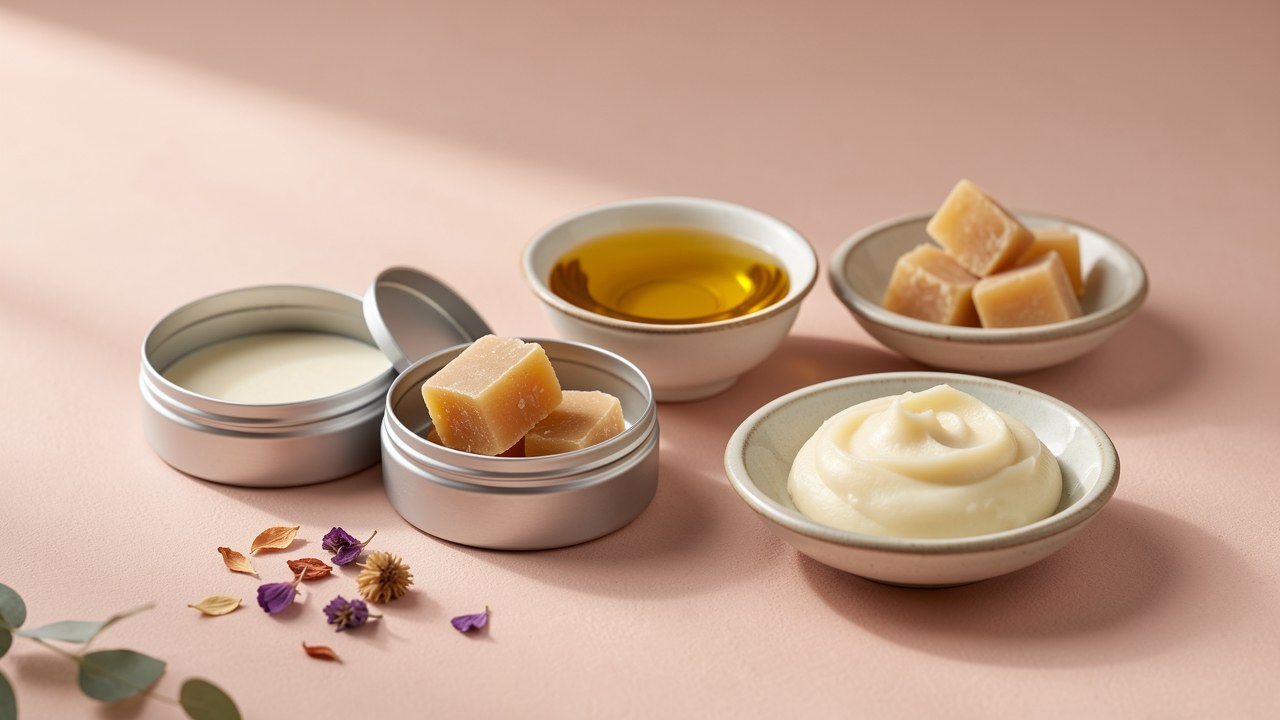
Petrolatum is the best-known occlusive in lip care. It appears in plain lip balms, healing ointments, and the base of many tinted products. Petrolatum is described as an occlusive agent that sits on top of the skin and helps hinder transepidermal water loss. Ingredient databases sometimes also tag petrolatum as an emollient, even though its primary described function is occlusive, so the category label on a database is not always a clean distinction. Waxes such as beeswax, candelilla wax, and carnauba wax act as occlusives and also give a lip balm or lipstick its structure, so they often appear near the top of an ingredient list. Butters such as shea butter sit between occlusive and emollient behavior: they help slow water loss while also softening the surface. Silicones such as dimethicone are occlusives that are also used to improve slip and feel, which is one reason formulators combine occlusives with emollients.
Cosmetic-grade petrolatum is described as having a long history of safe use, and one ingredient database states there is no evidence that cosmetic, USP grade petrolatum is carcinogenic. That is a general context statement from a secondary source, not a regulatory determination.
- Petrolatum: a heavy occlusive; the classic barrier ingredient in lip balms and healing ointments.
- Beeswax, candelilla wax, carnauba wax: occlusive and structuring; give a balm or bullet its shape.
- Mineral oil: a light occlusive often used in glosses and inexpensive balms.
- Shea butter and similar butters: partly occlusive, partly emollient; soften while helping seal.
- Dimethicone and other silicones: occlusive with a smooth, non-greasy feel; often paired with petrolatum or waxes.
Sources: INCIDecoder
Humectants: Glycerin, Hyaluronic Acid, and Similar Ingredients
Humectants attract and bind water in the upper layer of the skin, which is why they are described as helping replace lost moisture. On a lip product label, humectants appear most often in lip treatments, lip masks, and balms marketed for dry or chapped lips rather than in long-wear lipsticks, where added water would interfere with the formula.
Common humectants include glycerin, hyaluronic acid, urea, sorbitol, panthenol, honey, and alpha-hydroxy acids such as glycolic and lactic acid. Glycerin is one of the most widely used humectants in moisturizing products generally. Because humectants attract water, they are often paired with an occlusive in the same formula so that the water they attract stays near the surface rather than evaporating.
- Glycerin: the most common humectant in moisturizers; draws and holds water near the surface.
- Hyaluronic acid: a humectant that can hold a large amount of water relative to its weight.
- Urea, sorbitol, and panthenol: additional humectants used for hydration and skin-conditioning.
- Honey: a natural humectant often used in lip masks and treatment balms.
- Alpha-hydroxy acids such as glycolic and lactic acid: humectant at low levels, exfoliating at higher levels.
Emollients: Oils and Esters That Soften Lips
Emollients are ingredients used to soften and smooth the skin surface by filling in the gaps between skin cells. They provide some occlusive effect, but their primary job is to make the surface feel softer and more flexible rather than to add water or block water loss. The word comes from the Latin verb emollire, meaning to soften or soothe.
On a lip product label, emollients are the oils, esters, butters, and fatty ingredients that give a balm or lipstick its glide. Common examples include jojoba oil, squalane, shea butter, lanolin, ceramides, fatty alcohols, fatty acids, and vitamin E. In lipsticks and tinted balms, emollients also help pigments spread evenly, which is why they usually appear alongside colorants. Because emollients soften without being as heavy as petrolatum, formulators often combine them with occlusives to keep a product from feeling too thick.
- Jojoba oil and squalane: light emollients that spread easily and feel less greasy than petrolatum.
- Shea butter: emollient and partly occlusive; softens while helping reduce water loss.
- Lanolin: a heavier emollient often used in treatment balms for very dry lips.
- Ceramides: emollient skin-identical ingredients used in barrier-repair lip treatments.
- Fatty alcohols and fatty acids: emollient and texture-building; not the same as drying alcohols.
- Vitamin E: an emollient and antioxidant often listed near the end of a lip product ingredient list.
Sunscreen Actives and SPF Labeling in Lip Products
Lip products that claim SPF are regulated as over-the-counter sunscreen drug products in the United States, which means the sunscreen actives appear in a separate drug facts panel rather than being grouped with the cosmetic ingredients in the main list. That panel is where you will find the active ingredients and their percentages, along with directions and warnings.
The ingredient list you read for occlusives, humectants, and emollients covers the cosmetic part of the formula. The drug facts panel covers the UV protection part. When a lip product carries an SPF number, that number refers to the level of UVB protection tested for the product, and the label is required to state whether it protects against UVA as well. Reapplication instructions on the drug facts panel matter because lip products are easy to lick or wipe off.
The specific actives permitted in US lip products and the rules for how SPF is labeled are set by FDA regulation and can change. This guide therefore does not name individual sunscreen actives or list current SPF limits. The reliable place to read those details is the drug facts panel on the product itself, together with the FDA sunscreen labeling resources.
- SPF on a lip product refers to tested UVB protection for that product.
- Sunscreen actives appear in the drug facts panel, not in the cosmetic ingredient list.
- Broad-spectrum labeling indicates protection against UVA as well as UVB.
- Reapply according to the directions on the drug facts panel, especially after eating, drinking, or licking your lips.
- Permitted actives and SPF labeling rules are set by regulation, so check the product's own drug facts panel for current details.
Colorants, Dyes, and Pigments in Cosmetic Lip Products
Colorants are the ingredients that give lipstick, lip gloss, lip tint, and tinted balm their shade. In the United States, color additives used in cosmetics must be approved for that use, and the FDA separates color additives into two main groups: those subject to batch certification and those exempt from certification.
Color additives subject to certification are derived primarily from petroleum, are known as coal-tar colors, and most synthetic organic colorants fall in this category. Their official names are designated by the FDA and use the prefixes D&C (drug and cosmetics), FD&C (food, drugs and cosmetics) or Ext. D&C (external drugs and cosmetics), followed by a color designation and number. For example, FD&C Yellow 5, D&C Red 6, and Ext. D&C Violet 2 are certifiable primary colors, which contain no extenders or diluents. Colors made by combining straight colors with substrates such as sodium, potassium, aluminum, barium, calcium, strontium or zirconium are known as lakes; they follow the same restrictions as the primary colors and add the name of the precipitating metal and the word lake, for example FD&C Yellow 5 Al Lake.
Color additives exempt from certification include natural organic and synthetic inorganic colorants obtained largely from mineral, plant or animal sources. Batch certification is not required for these, but purity must be tested by the manufacturer to meet FDA specifications. Examples include titanium dioxide, iron oxides, mica, ultramarines, annatto, and carmine. Some of these are approved for general use including lipsticks, while others are restricted to external use or eye-area use. For instance, ultramarines are approved for eye area and external use but not for general use including lipsticks; iron oxides, mica, and manganese violet are approved for eye area, general use including lipsticks, and external use when they conform to FDA specifications.
Two other categories are worth knowing when you read a lip product label. Some color additives are permitted only for external use and are not approved for lipstick use, such as D&C Red No. 17, D&C Red No. 31, D&C Red No. 34, D&C Blue No. 4, D&C Orange No. 4, and D&C Violet No. 2. Others are permitted for lip products only up to a maximum concentration: FDA regulations specify that D&C Red No. 33 and D&C Red No. 36 are each permitted for cosmetic lip products at not more than 3 percent by weight of the finished cosmetic product. Several color additives are listed as approved for general use including lipsticks, for example D&C Red No. 6, D&C Red No. 7, D&C Red No. 21, D&C Red No. 22, D&C Red No. 27, D&C Red No. 28, D&C Red No. 30, FD&C Red No. 40, FD&C Yellow No. 5, and FD&C Yellow No. 6. Carbon black as a cosmetic color additive in the United States is called D&C Black No. 2, a high-purity carbon black prepared by the oil furnace process.
The distinction between a dye and a pigment matters for how the product behaves: dyes tend to stain the lip surface and can leave a tint behind, while pigments sit on top and provide coverage that wipes off. Many long-wear lip products use both. On a label, colorants appear under names such as FD&C or D&C followed by a color and number, or under INCI names like CI 19140 or CI 73360. If you are trying to identify a specific shade, look for the color index numbers rather than the marketing name, because the marketing name is unique to the brand while the color index number is the same across products.
The FDA summary of color additives states that it is not intended to be used as a substitute for the regulations listing color additives for use in the United States, which are located in Title 21 of the Code of Federal Regulations Parts 73, 74, 81 and 82. The FDA also notes that color additives listed for use in drugs or cosmetics are not permitted for use in eye area products, injected products or surgical sutures unless the regulation for the color additive states otherwise.
- Color additives are divided into those subject to batch certification and those exempt from certification.
- Certifiable colors use FDA-designated names with FD&C, D&C, or Ext. D&C prefixes followed by a color and number.
- Lakes combine a straight color with a substrate such as aluminum or calcium and include the word lake in the name.
- Exempt-from-certification colors include titanium dioxide, iron oxides, mica, ultramarines, annatto, and carmine.
- Some colorants are approved for lipsticks, some are restricted to external use only, and some have a 3 percent maximum for lip products.
- Color index numbers such as CI 19140 or CI 73360 identify the same colorant across brands.
Sources: U.S. Food and Drug Administration, New York Society of Cosmetic Chemists, Handcrafted Soap and Cosmetic Guild, CosmEthics on Medium
Flavors, Fragrances, and Potential Sensitivities
Flavors and fragrances are added to lip products for taste, scent, or both, and they are among the ingredients most likely to be noticed by people whose lips are easily irritated. A flavor may be a single compound such as vanillin or a blend; a fragrance may be a single aroma chemical or a mixture covered on the label by the word fragrance or parfum. One ingredient database notes that fragrance is listed as a generic term on ingredient lists that may be made up of 30 to 50 chemicals on average and can have as many as 200 components. That same database describes fragrance as the number one cause of contact allergy to cosmetics and states that fragrance of any type, natural or synthetic, should be avoided with sensitive skin. That characterization comes from a secondary ingredient-decoding source rather than a regulator or clinical body, so treat it as a cited opinion rather than a firm finding.
Certain individual fragrance components are also called out on labels. Linalool, for example, is described as a super common fragrance ingredient found both in plants and in cosmetic products, and a product containing linalool that has been opened for several months is described as more likely to be allergenic than a fresh one. Real lip product ingredient lists reflect this: a tinted balm such as Vaseline Lip Care Rosy Lips lists fragrance-related ingredients alongside colorants.
If your lips sting, itch, or peel after using a flavored or scented lip product, the flavor or fragrance is one reasonable place to start looking. Some people also react to certain essential oils used as natural flavoring or scent, such as peppermint, cinnamon, or citrus oils. The exact list of ingredients that can sensitize depends on the individual and the formula, and no single list applies to everyone.
A simple approach is to switch to an unflavored, unfragranced balm for a week or two and see whether your lips settle. If they do, reintroduce one product at a time so you can identify the trigger. If irritation continues or is severe, a dermatologist can help you identify the specific ingredient.
- Flavors may be single compounds or blends; labels often list them generically.
- Fragrance or parfum on a label can stand in for a mixture of aroma chemicals.
- Linalool is a common fragrance ingredient that appears in plants and in cosmetic products.
- Peppermint, cinnamon, and citrus oils are common flavor or scent ingredients that some people find irritating.
- An unflavored, unfragranced balm trial can help narrow down whether a flavor or fragrance is the trigger.
Sources: INCIDecoder
Preservatives and Antioxidants in Lip Formulations
Preservatives protect a lip product from bacteria, mold, and yeast that can grow in any formula containing water. Water-containing products such as lip masks, lip creams, and some liquid lip treatments are the ones most likely to list preservatives, since the water phase is what microbes need. Common preservative names include phenoxyethanol, parabens, and potassium sorbate, though the specific choice depends on the formula and the brand.
Anhydrous products, those made only of oils, waxes, and butters with no water, are much less vulnerable to microbial growth because there is no water phase for microbes to grow in. For that reason, anhydrous lip balms and lipsticks usually rely not on preservatives but on antioxidants to protect the oils and butters from oxidation, the breakdown that makes a product smell rancid or change color and texture. Antioxidants such as vitamin E, rosemary extract, and BHT are added to slow that process. If the ingredient list of a solid lip balm contains no preservative at all, that is generally expected rather than concerning.
The word preservative can sound alarming, but in a water-containing lip product the alternative, a formula with no preservative at all, is the one that carries the greater risk of microbial contamination. If you prefer to avoid a specific preservative, the ingredient list is the reliable place to check whether it is present.
- Preservatives are used mainly in water-containing lip products such as lip masks and lip creams.
- Anhydrous balms and lipsticks have no water phase, so they rarely need preservatives.
- Antioxidants such as vitamin E, rosemary extract, and BHT slow oxidation of oils and butters.
- Oxidation shows up as a rancid smell, a color change, or a change in texture.
- If you want to avoid a specific preservative, read the full ingredient list rather than relying on front-of-pack claims.
Frequently asked questions
What does petrolatum actually do for lips?
Petrolatum is an occlusive, which means it forms a physical barrier on top of the lips to help reduce water loss rather than adding water itself. It appears first on the ingredient list of many plain lip balms and healing ointments, and cosmetic-grade petrolatum is described as having a long history of safe use. If your lips are very dry or cracked, a petrolatum-based balm is a reasonable starting point; if you prefer a lighter feel, look for a formula that combines petrolatum with emollients such as jojoba oil or squalane.
Sources: INCIDecoderAre natural oils better than synthetic emollients?
Not inherently. Natural oils such as jojoba and squalane and synthetic emollients such as certain esters and silicones all work by softening and smoothing the lip surface, and both categories can be well formulated or poorly formulated. What matters more is whether the emollient is paired with an occlusive to help hold moisture in, and whether the overall formula suits your lips. If you have a sensitivity, the specific ingredient matters more than whether it is labeled natural.
Sources: INCIDecoderWhat does SPF mean on a lip balm label?
SPF on a lip balm refers to the level of UVB protection tested for that product. Lip products that claim SPF are regulated as over-the-counter sunscreen drug products in the United States, so the sunscreen actives appear in a separate drug facts panel rather than in the cosmetic ingredient list. That panel also states whether the product is broad spectrum, which indicates UVA protection, and gives reapplication directions. Because permitted actives and SPF labeling rules are set by regulation, check the drug facts panel on the product for current details.
Can lip product ingredients cause irritation?
Yes, some people react to certain ingredients in lip products. Flavors, fragrances, essential oils used as flavoring or scent, some preservatives, and some colorants are among the ingredients most often associated with contact sensitivity on the lips, and one ingredient database describes fragrance as the number one cause of contact allergy to cosmetics. If your lips sting, itch, or peel after using a product, switching to an unflavored, unfragranced balm for a week or two and then reintroducing products one at a time can help you identify the trigger. If irritation is severe or persistent, a dermatologist can help narrow down the specific ingredient.
Sources: INCIDecoderWhy do some lip balms list no preservative at all?
A plain balm made only from petrolatum, waxes, and oils has no water phase, so there is little for bacteria, mold, or yeast to grow in. That is why anhydrous lip balms and lipsticks rarely need preservatives and instead rely on antioxidants to slow oxidation of the oils and butters. Water-containing lip products such as lip masks and lip creams are the ones that typically do list preservatives, because the water phase can support microbial growth.
Why do FD&C and D&C names appear on a lipstick label?
Those prefixes identify color additives that the FDA has approved for cosmetic use and that are subject to batch certification. FD&C stands for food, drugs and cosmetics, D&C stands for drug and cosmetics, and Ext. D&C stands for external drugs and cosmetics. A name like FD&C Yellow 5 or D&C Red 6 tells you which regulated color additive is in the formula, and a lake version such as FD&C Yellow 5 Al Lake tells you that the color has been combined with a substrate such as aluminum.
Sources: U.S. Food and Drug Administration, New York Society of Cosmetic ChemistsSources
- Color Additives Permitted for Use in Cosmetics | FDA — U.S. Food and Drug Administration
- Summary of Color Additives for Use in the United States in Foods, Drugs, Cosmetics, and Medical Devices | FDA — U.S. Food and Drug Administration
- Cosmetic Colorants - NYSCC — New York Society of Cosmetic Chemists
- Cosmetic Color Additives — Handcrafted Soap and Cosmetic Guild
- Vaseline Lip Care Original ingredients (Explained) — INCIDecoder
- Vaseline Lip Care Original Lip Balm ingredients (Explained) — INCIDecoder
- Vaseline Lip Care Rosy Lips ingredients (Explained) — INCIDecoder
- Vaseline Lip Therapy Original Mini ingredients (Explained) — INCIDecoder
- The world of colors in cosmetics — CosmEthics on Medium